
Introduction: The Architecture of an Infrastructure Giant
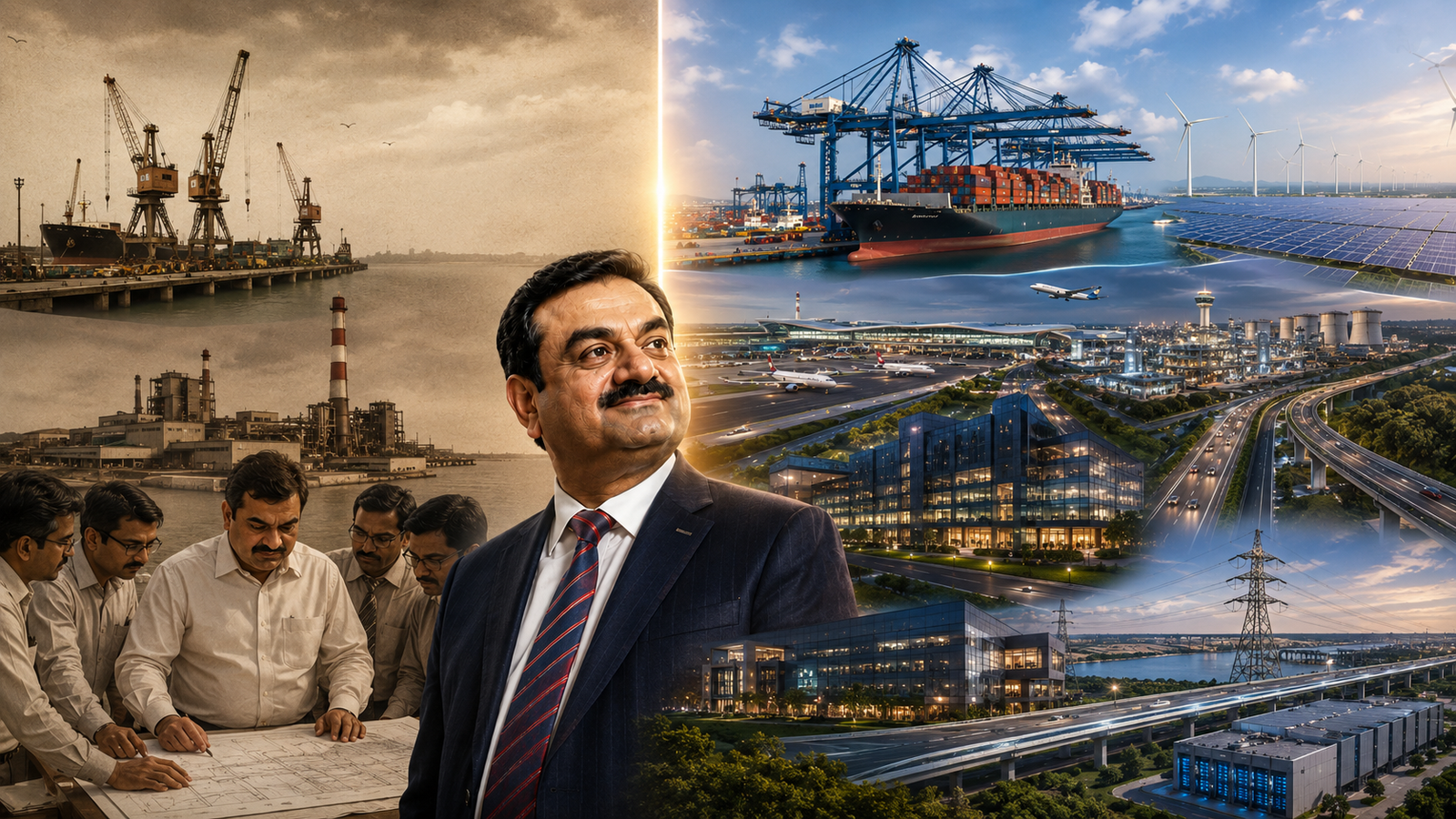
The evolution of the Adani Group in the modern history of the Indian economy is not merely a tale of corporate conglomerate success, but a living testament to India’s rapid infrastructural transformation. Beginning in 1988 with an initial capital of just Rs 5 lakhs as a simple commodity trading firm, this enterprise has grown by 2026 into one of India’s largest multi-sectoral business empires. The conglomerate has expanded its operations to span the nation’s largest private ports, airports, power transmission grids, cement manufacturing plants, and massive utility-scale renewable energy parks.
By the financial year 2024, the Adani Group recorded a total revenue of INR 3.09 lakh crore (approximately USD 32 billion) and a net income of INR 41,263 crore (approximately USD 4.3 billion), with a direct workforce of around 36,000 employees. Public and media discussions—across outlets like Aaj Tak, India Today, and prominent digital platforms—frequently debate the Adani Group’s deep strategic alignment with India’s “nation-building” agenda. However, this journey has not been without extreme turbulence. It has been marked by intense political controversies, a highly leveraged growth model, rigorous regulatory scrutiny, and high-profile legal battles fought with global short-sellers and US federal prosecutors inside international courtrooms.
Pre-2014 Era: Regional Foundations and the Gujarat Launchpad
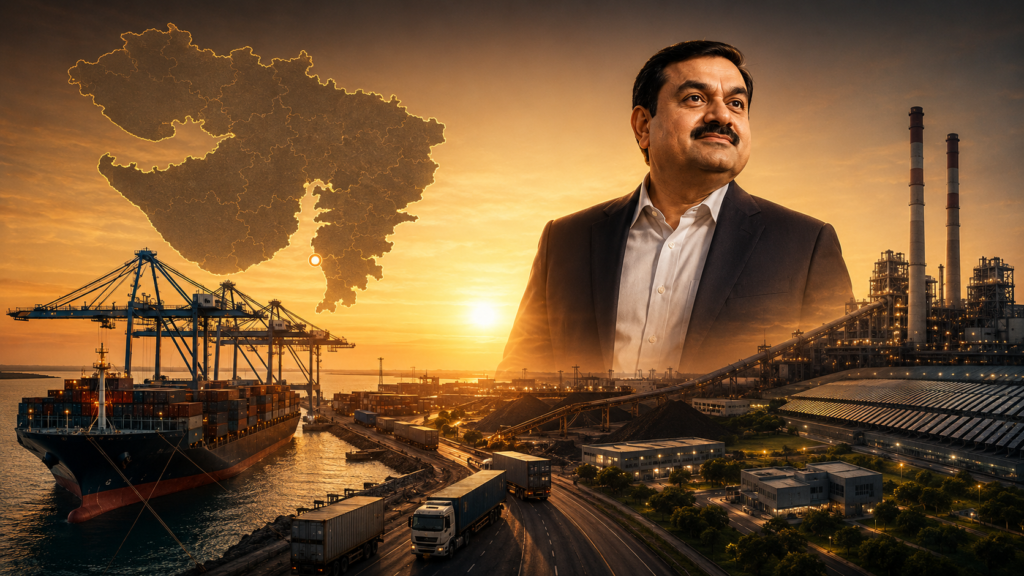
Before the landmark shift in India’s political landscape in May 2014, the Adani Group operated primarily as a robust, Gujarat-focused infrastructure company. The group’s founder, Gautam Adani, initially focused on import-export operations, but the acquisition of the concession agreement to develop and operate the Mundra Port in Gujarat in the mid-1990s marked the most critical turning point in the group’s history.
During the 2000s, the group’s development remained deeply aligned with the industrialization and infrastructure policies of the Gujarat state government. This strategic synergy enabled the Adani Group to acquire vital coastal land, develop the Mundra Special Economic Zone (SEZ), and enter the power generation sector in 2006 by establishing India’s largest private thermal power plant in Mundra.
In this initial phase, the group’s financial standing and Gautam Adani’s personal net worth mirrored the cyclical nature of commodity markets and the capital-intensive demands of infrastructure development.
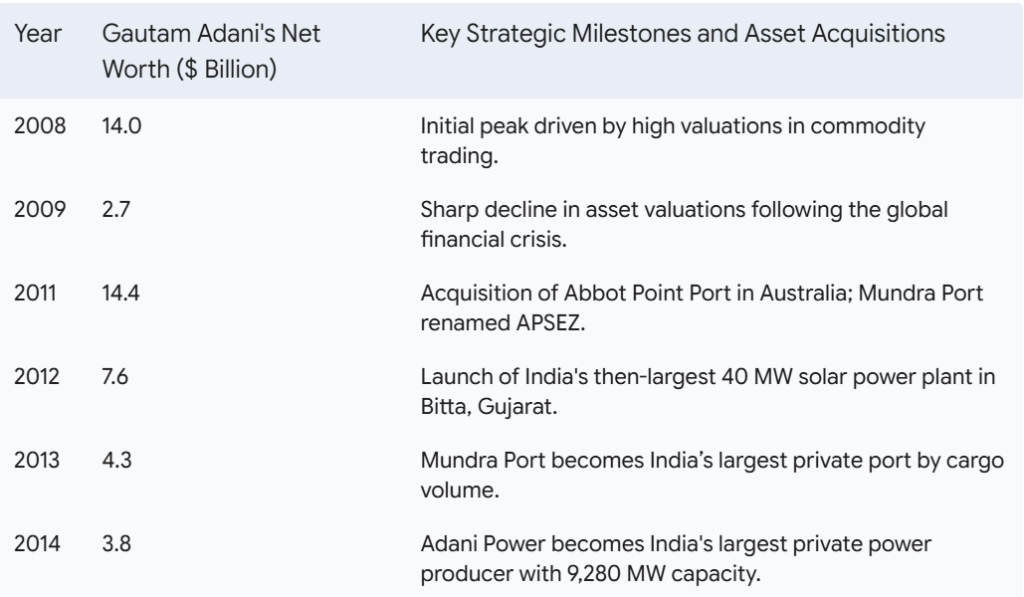
This historical data shows that prior to 2014, the group was highly efficient and regionally dominant but had limited reach among global retail investors and international capital markets.
Post-2014 Unprecedented Expansion: Nation-Building and Infrastructure Nationalization
Following the formation of a new government led by the Bharatiya Janata Party (BJP) in May 2014, the pace and geographical reach of the Adani Group’s business expansion accelerated extraordinarily. During this period, instead of relying solely on organic growth, the group aggressively consolidated its position through debt-driven strategic acquisitions.
Business analysts point out that the Adani Group systematically aligned its commercial projects with the government’s long-term economic objectives—such as upgrading logistics networks, expanding power transmission, and scaling renewable energy—allowing them to benefit directly from policy incentives.
Dominance in Maritime Logistics
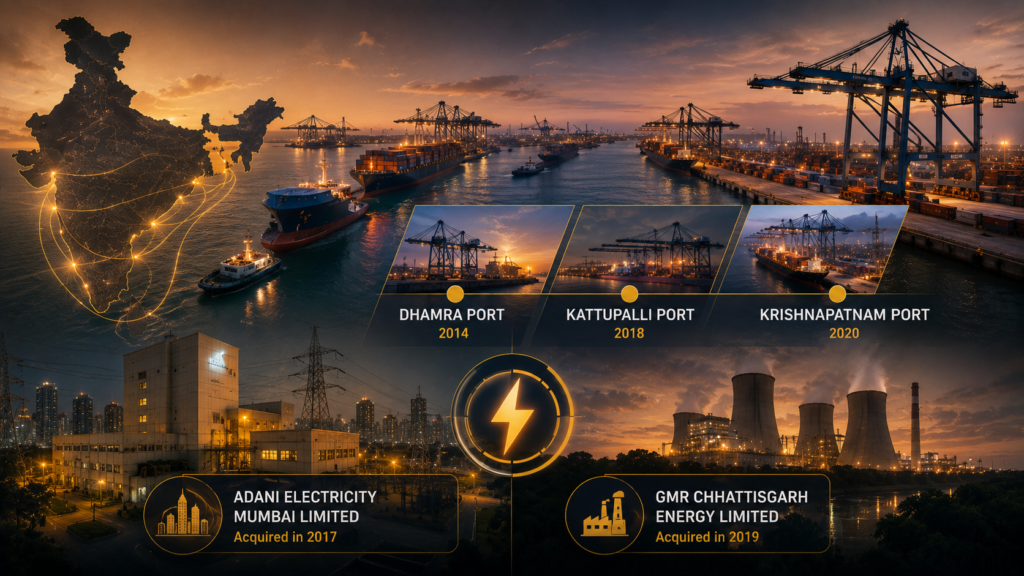
In May 2014, the group acquired the Dhamra Port on the eastern coast—a 50:50 joint venture between Tata Steel and L&T Infrastructure—for INR 5,500 crore. This was followed by the acquisition of Kattupalli Port near Chennai in 2018 and Krishnapatnam Port in Andhra Pradesh in 2020. These strategic moves consolidated Adani Ports and Special Economic Zone’s (APSEZ) dominance across both the eastern and western coasts of India, a strategy often described as a maritime “string of pearls”.
Urban Utility and Energy Expansion
In December 2017, the group acquired the Mumbai power generation, transmission, and distribution business of Reliance Infrastructure for INR 18,800 crore (USD 2.89 billion), resulting in the launch of “Adani Electricity Mumbai Limited” (AEML). This deal directly linked millions of retail consumers in the country’s financial capital to Adani’s utility grid. Additionally, the acquisition of GMR Chhattisgarh Energy Limited in 2019 further boosted the group’s thermal power generation capabilities.
Monopoly in the Aviation Sector
In February 2019, when the Government of India invited bids for the privatization of six major airports, the Adani Group—despite having no prior experience in airport management—secured 50-year concession leases for all six airports (Ahmedabad, Lucknow, Mangaluru, Jaipur, Guwahati, and Thiruvananthapuram) through highly competitive financial bids. Soon after, in August 2020, the group entered into a debt-acquisition agreement with the financially strained GVK Group to acquire a majority stake in Mumbai International Airport and the upcoming Navi Mumbai International Airport. This acquisition gave the Adani Group control over nearly one-fourth of India’s total airport passenger traffic.
Entry into Cement and Core Materials
In May 2022, the Adani family sent waves through global markets by acquiring the Indian businesses of Swiss building materials giant Holcim—Ambuja Cements and its subsidiary ACC—for USD 10.5 billion. Executed through an overseas Special Purpose Vehicle (SPV), this transaction represented the largest infrastructure and materials merger and acquisition (M&A) in Indian history, overnight transforming Adani into India’s second-largest cement manufacturer
Business Incubator Model and Political-Business Alignment
The core engine behind this rapid growth rate is the group’s unique corporate structure and financial engineering, known as the “Incubator Model”.
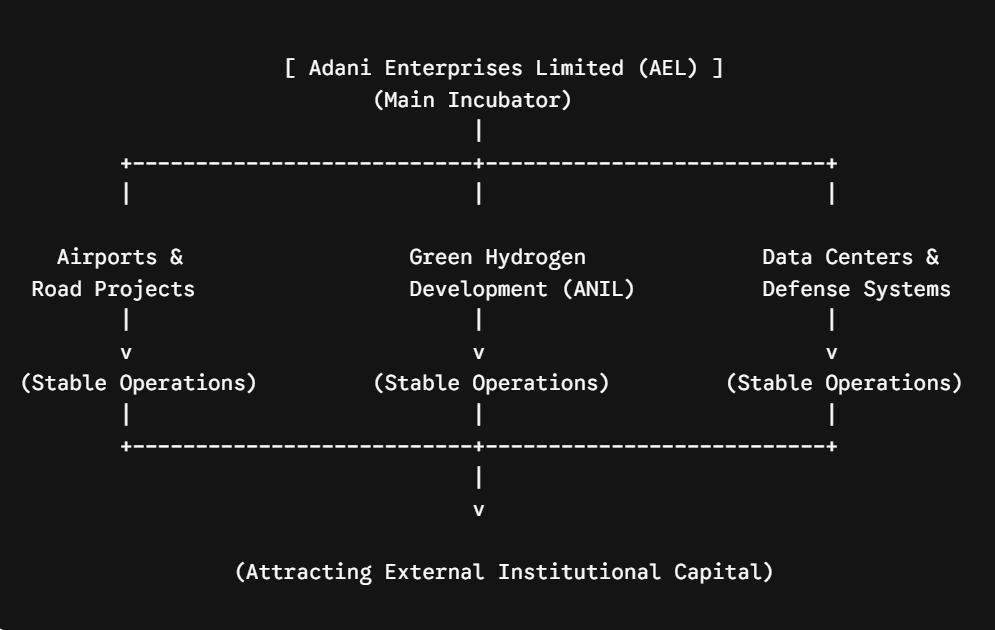
Under this model, the group’s flagship listed entity, Adani Enterprises Limited (AEL), acts as a corporate nursery for new, high-risk infrastructure ventures. Once these businesses mature, stabilize their operations, and generate a steady EBITDA, they are demerged from the parent company and listed independently on the stock exchanges.
This strategy allows the group to de-leverage its balance sheet and attract dedicated international investors. Through this strategy, several major listed entities were spun off:
- Adani Transmission (now Adani Energy Solutions): Listed in 2015, becoming the country’s largest private power transmission company.
- Adani Green Energy Limited (AGEL): Established in 2015 and listed in 2017, it is now a global leader in utility-scale renewable energy.
- Adani Total Gas: Formed via a 50:50 joint venture with French energy giant TotalEnergies, growing into India’s largest city gas distribution network.
Analysts noted that while this aggressive, debt-fueled expansion raised concerns among global credit rating agencies—such as Fitch Group’s CreditSights, which termed the group “deeply overleveraged” in 2022—the group mitigated these risks by shifting away from domestic state-bank loans toward international bond markets and direct foreign direct investments (FDI).
Toward the Global Peak: Overtaking Mukesh Ambani and Bill Gates
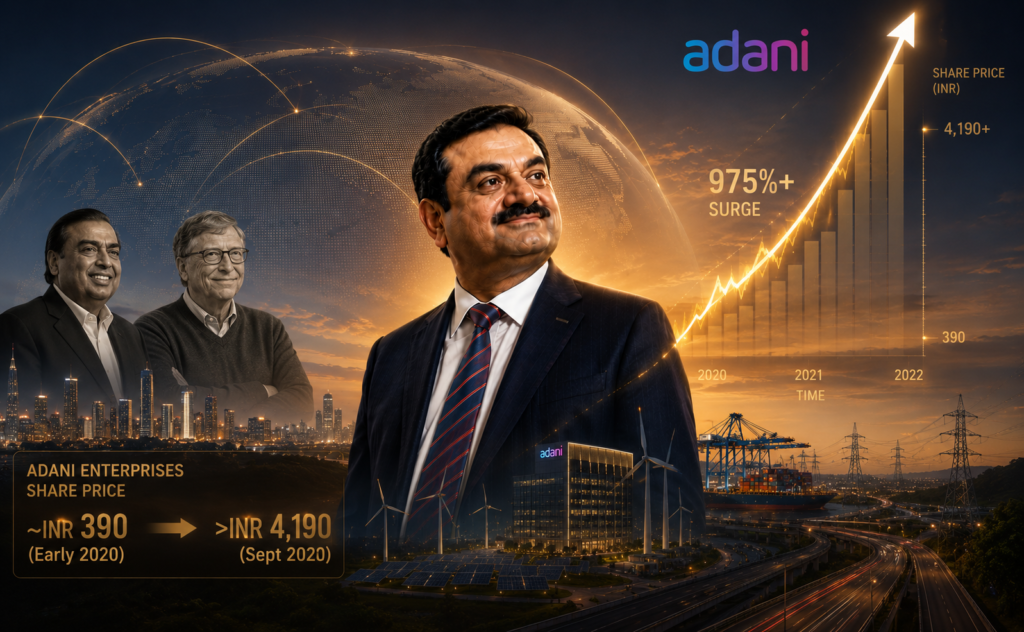
Between 2020 and 2022, the Adani Group’s listed stocks witnessed an unprecedented hyperbolic rally on the Indian stock exchanges. Shares of Adani Enterprises skyrocketed by over 975% in less than three years, surging from approximately INR 390 to an all-time high of over INR 4,190 in September 2022. This exponential valuation surge dramatically altered Gautam Adani’s personal net worth.
In February 2022, Gautam Adani overtook Reliance Industries’ Mukesh Ambani to become the richest individual in Asia. Shortly after, in July 2022, with a net worth of USD 112.5 billion, he surpassed Microsoft co-founder Bill Gates to become the world’s fourth-richest person. While Gates’ wealth had contracted primarily due to his massive USD 20 billion philanthropic donation to the Bill & Melinda Gates Foundation, Adani’s rise remained an extraordinary milestone.
By August 2022, the Bloomberg Billionaires Index ranked Gautam Adani as the world’s third-richest person with a net worth of USD 137 billion—marking the first time an Asian entrepreneur had broken into the global top three. In September 2022, his net worth briefly peaked at USD 152.2 billion, momentarily placing him second globally, trailing only Elon Musk.
Reflecting on this financial ascent during an exclusive interview with Aaj Tak and India Today in December 2022, Gautam Adani remarked:
“These rankings and numbers do not mean anything to me. This is all media hype. I am a first-generation entrepreneur who built everything from scratch. I enjoy challenges; the bigger the challenge, the happier I am. What gives me satisfaction is the opportunity to change people’s lives and move the country forward through infrastructure development”.
The Hindenburg Strike and Regulatory Battles: Indian Investigative Agencies’ ‘Agni-Pariksha’

The financial peak of the Adani Group faced a massive existential crisis in January 2023. On 24 January 2023, New York-based short-seller firm Hindenburg Research published a damning report accusing the Adani Group of executing “the largest con in corporate history”.
Key Allegations and Market Collapse
The Hindenburg report alleged that the Adani Group engaged in brazen stock manipulation, accounting fraud, and the illicit use of offshore shell entities located in tax havens like Mauritius to artificially inflate share prices.
The publication triggered panic selling across Dalal Street. Within weeks, the shares of the seven listed Adani companies plummeted by 3% to 7% daily, wiping out over USD 100 billion from the group’s collective market capitalization. In a move to protect retail investors from extreme market volatility, the group withdrew its fully subscribed INR 20,000 crore Follow-on Public Offer (FPO). Gautam Adani’s personal net worth fell to USD 47.2 billion, causing him to drop from 3rd to 22nd on global wealth trackers.
Indian Judiciary and SEBI’s Final Verdict
Amid public outrage and political demands for a court-monitored probe, several public interest litigations (PILs) were filed in the Supreme Court of India, questioning the market regulator SEBI’s independence.
The Supreme Court set up a high-level Expert Committee, chaired by retired Justice Abhay Manohar Sapre, to review regulatory frameworks and investigate potential failures. On 3 January 2024, the Supreme Court delivered its final verdict, refusing to transfer the probe from SEBI to an independent Special Investigation Team (SIT). The court held that there was no cogent justification to doubt SEBI’s competence and observed that foreign short-seller reports cannot be treated as infallible proof.
In September 2025, after a multi-year, comprehensive probe, SEBI officially cleared the Adani Group of all key allegations. In its final orders, SEBI detailed the following findings :
- Fund Routing Allegations: SEBI investigated claims that funds were siphoned off and routed through entities like Adicorp Enterprises. The regulator found that these inter-corporate loans were fully repaid with interest, and no evidence of fraud or fund siphoning was found.
- Related Party Transactions (RPTs): SEBI concluded that under the listing regulations applicable when the transactions took place, the deals did not technically qualify as related-party transactions, as there was no decisive control or influence over decision-making. While SEBI introduced stricter “purpose and effect” RPT rules starting in April 2023, these rules could not be applied retroactively.
- Insider Trading and Shareholding Norms: The regulator found no evidence of insider trading or violations of Minimum Public Shareholding (MPS) rules, officially closing the domestic investigation.
Struggle on the US Legal Front: Settlement of SEC and DOJ Cases

While the group secured a major victory at home, a fresh international legal crisis erupted in late 2024 when the US Department of Justice (DOJ) and the Securities and Exchange Commission (SEC) filed parallel securities fraud cases against Gautam and Sagar Adani in a New York federal court.
Allegations by US Regulators
The US agencies alleged that Adani Green Energy Limited (AGEL) raised over USD 175 million from US investors via a USD 750 million bond offering in September 2021 by falsely claiming strict adherence to anti-bribery policies. In reality, the agencies alleged, the defendants were orchestrating a scheme to pay bribes to Indian state officials to secure solar energy contracts.
Adani’s Legal Team’s Aggressive Defense
In April 2026, Adani’s global defense counsel submitted a robust motion to dismiss the SEC’s complaint before the US District Court for the Eastern District of New York, raising strong jurisdictional and technical arguments :
- Lack of Personal Jurisdiction: The defense argued that the defendants are Indian citizens, the alleged conduct occurred entirely in India, the bonds were not traded on US exchanges, and the subscription agreements were not governed by US law.
- Gautam Adani’s Non-Involvement: Corporate liability cannot be converted to personal criminal liability unless direct action is proven. The defense showed that Gautam Adani was not involved in AGEL’s daily bond offerings and did not attend any management meetings where the offering circulars were approved between 2020 and 2024.
- Zero Investor Losses: The defense highlighted that no US investors suffered financial losses, as AGEL consistently honored all debt and bond obligations.
- Puffery Defense: The defense argued that general ESG compliance statements in corporate circulars constitute “puffery” or generic optimism, which cannot legally sustain actionable fraud claims.
The Historic Settlement of May 2026
Following intense legal maneuvers and diplomatic engagements, the US legal cases reached a permanent and comprehensive resolution in May 2026.
| Date | Development | Details |
|---|---|---|
| 14 May 2026 | Civil Settlement | Settlement reached without admitting or denying allegations |
| Gautam Adani | Agreed to pay $6 million civil penalty | |
| Sagar Adani | Agreed to pay $12 million civil penalty | |
| 19 May 2026 | Case Closure | Case reportedly dismissed “with prejudice” |
| Prosecutors’ Position | Cited lack of clear U.S. jurisdictional connections | |
| Corporate Resolution | Approximately $275 million corporate settlement and cooperation agreement |
On 14 May 2026, Gautam and Sagar Adani entered a civil consent decree with the SEC without admitting or denying the allegations. Under the court-approved settlement, Gautam Adani agreed to pay a civil penalty of USD 6 million, and Sagar Adani agreed to pay USD 12 million, bringing the civil proceedings to a close.
A few days later, on 19 May 2026, the DOJ moved to permanently drop all criminal fraud and conspiracy charges against both Gautam and Sagar Adani. US federal prosecutors conceded that the case lacked sufficient evidence and direct “US linkages” to sustain the indictment.
The New York federal court ordered the criminal indictment “dismissed with prejudice,” preventing the US government from ever filing the same charges again. This final resolution—secured alongside a USD 275 million corporate settlement and proactive cooperation—eliminated the ultimate threat hanging over the group’s global expansion plans.
Return to the Financial Markets: Stock Performance Analysis and Wealth Rebuilding
With regulatory clearances in India and the permanent resolution of criminal cases in the United States, investor confidence in the Adani Group surged dynamically between 2025 and 2026. Supported by domestic institutional buyers and foreign investment inflows, the group’s listed firms staged a historic market rally, recouping nearly USD 150 billion in market value lost since the Hindenburg crisis.
By March 2026, shares of Adani Enterprises recovered to trade between INR 1,961 and INR 2,090 on the National Stock Exchange (NSE), with its market capitalization stabilizing between INR 2.26 lakh crore and INR 2.52 lakh crore.
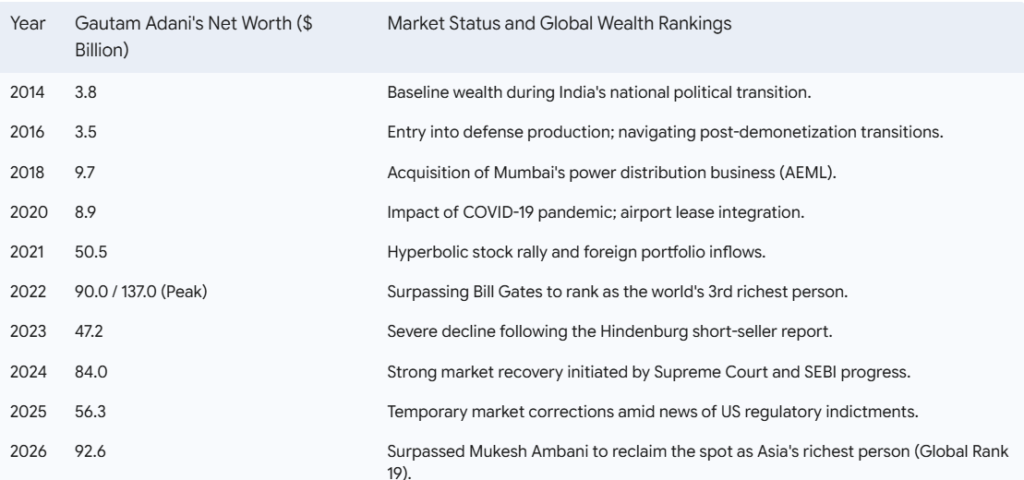
According to the Bloomberg Billionaires Index updated in April 2026, Gautam Adani’s net worth rebounded to USD 92.6 billion, ranking him 19th globally, as he once again surpassed Mukesh Ambani to regain the title of Asia’s richest individual
Future Roadmap: Mega-Projects up to 2032
As of 2026, the Adani Group’s long-term commercial strategy is centered on two massive, highly ambitious projects designed to reshape India’s urban and green energy landscape.
Dharavi Redevelopment Project (DRP)
Rebuilding Dharavi—one of Asia’s largest informal settlements located in the heart of Mumbai—represents one of the most complex urban renewal initiatives in global history. The 253.7-hectare project aims to rehouse approximately 10 lakh (1 million) residents into a modern, planned urban township.
- Joint Venture Structure: The redevelopment is executed via a Special Purpose Vehicle (SPV) named “Navbharat Mega Developers Private Limited” (NMDPL), consisting of an 80% stake held by Adani Properties and a 20% stake held by the Maharashtra government’s Slum Rehabilitation Authority (SRA).
- Project Cost and Timeline: The total project cost is estimated at INR 95,790 crore (approximately USD 11.5 billion), with a final completion deadline set for 13 January 2032.
- Ground Execution (2025-2026): Physical groundbreaking began on 14 January 2025 on a railway land parcel in Matunga West. By April 2026, the authority began issuing formal vacate notices to approximately 8,700 chawl households in its first physical relocation phase. Off-site rehabilitation transit sites have been finalized at Malad-Malvani (118 acres) and Goregaon Motilal Nagar (143 acres).
- Resident Benefits: Ground-floor residents with verified pre-2000 occupancy are entitled to receive a 350 to 745 square foot permanent apartment completely free of cost. The developer will recover its multi-billion dollar investment by selling premium free-sale commercial and residential real estate on the cleared, prime central Mumbai land.
Khavda Renewable Energy Park
Located in Kutch, Gujarat, near the India-Pakistan border, the Khavda Renewable Energy Park is the world’s largest clean energy facility.
- Target Capacity: Spanning 538 square kilometers of salt desert, the park aims to reach an installed capacity of 30 GW of hybrid solar and wind power by 2029.
- Battery Storage: To address the intermittency of renewable energy, Adani Green Energy (AGEL) has operationalized a 1,376 MWh Battery Energy Storage System (BESS) at the site, representing one of the largest single-location battery deployments globally.
- Green Hydrogen: Under Adani New Industries Limited (ANIL), the group plans to establish a massive green hydrogen ecosystem, targeting 1 MMTPA of production by FY27 and scaling up to 3 MMTPA over the next decade.
Conclusion: Adani’s Permanent Position in Indian Capitalism and the Global Market
The tumultuous trajectory of the Adani Group between 2014 and 2026 demonstrates that the conglomerate has successfully integrated its balance sheet with India’s core sovereign infrastructure. The group’s survival and subsequent vindication following the Hindenburg short-seller attack and US DOJ indictments reflect an extraordinary capability in crisis management, global legal navigation, and financial resilience.
By securing clean chits from SEBI at home and obtaining permanent “dismissals with prejudice” from criminal courts in the US, the group has successfully restored its international market access and investor creditworthiness. Armed with the Dharavi Urban Transformation and the 30 GW Khavda energy facility, the Adani Group is solidly positioned to dominate both the domestic urban-real estate landscape and the global green energy transition over the next decade.